

Value Betting Mastery: Turning Odds into Profits
To lead off this lesson, let’s first define what we mean by a “value bet.” A value bet is not just betting small to induce someone into calling. A value bet means you have sized your chance the perfect amount to get the most value possible from a hand worse than yours.
Players make a common mistake on the river: checking behind “just in case I’m beaten” instead of betting for value. As you are about to see, it doesn’t always pay to be conservative. You aim to maximize your gains when you are ahead, not just win pots. You must practice good hand-reading skills and narrow your opponent’s range to do this effectively. You can quantify “just in case” and “sometimes I’m beaten here.” And what does “sometimes” really mean? 10% of the time, 20%, 50%?
An Expected Value Perspective
To put this into an expected value perspective, let’s say you are in a cash game and have a 100 big blind (bb) stack on the river; the pot is 16bb, and your opponent checks. You may not be ahead 100% of the time, and they aren’t going to call 100% of the time, but to determine how much value you can get out of a hand, you should always ask yourself, “How often do I think I am ahead here and how often will they call?”. You can call this your “value equity.”
Let’s say you feel 80% confident you have the best hand, and your opponent will never fold a better one. Now, they may also fold a worse hand sometimes, so for this example, let’s say they fold 20% of the time. So, 60% of the time, you will get called and win money (assuming you are betting a reasonable amount). For this example, ‘let’s say we bet 50% of the pot or 8bb.
As you can see, both checking and betting are profitable and will increase the 100bb stack you had on the river. However, betting will earn you ten more BB in the long run, even though you’ll sometimes be beaten. You can use the above chart to help you analyze your hands by determining your opponent’s hand range and your equity vs. those hands using a tool like Poker Stove.
Bet Sizing
In the above example, we bet 50% of the pot, assuming we would get called 80% of the time. That and any other model can never duplicate your read on a specific situation. How you size your bets to maximize your ability to get called will be based on the board texture, table image, opponent’s image, stack sizes, and several other factors.
Regarding bet sizing, one common misconception is that the smaller you bet, the more likely you are to get called. While that can be true in theory, at some point, you will get to the end of diminishing returns, meaning that you will get the same amount of calls as you shrink the size of your bet. In many situations, for example, a 2bb chance will get the same amount of calls as a 1bb bet and yield double the profit.
In some instances, a larger bet may even get you a higher % of calls because the type of poker player you are against may see that larger bet as a bluff and be more willing to call you down. So your thought process shouldn’t simply be “Will they call me or not?” it should be “What size can I make my bet to maximize my profit?”.
Below is a hypothetical example to illustrate the point. Let’s pretend this is early in a no-limit, hold ’em tournament. After the turn, there are 600 in the pot, and the blinds are 25/50. You put your opponent on a range you think will likely call.
As you can see, you may lose money if you bet 400 instead of 300, but even though your opponent will call you more when you bet 300, you will make more money in the long run if you bet 600.
Going for Thin Value
This value is defined as betting in a spot where your opponent only has a small range that will call you with a worse hand. Reading your opponent’s hand confidently will enable you to get value where other poker players may not, and this is a major difference between good and great players. In these spots, you will likely only be able to bet a small amount to get a call. Here’s an example:
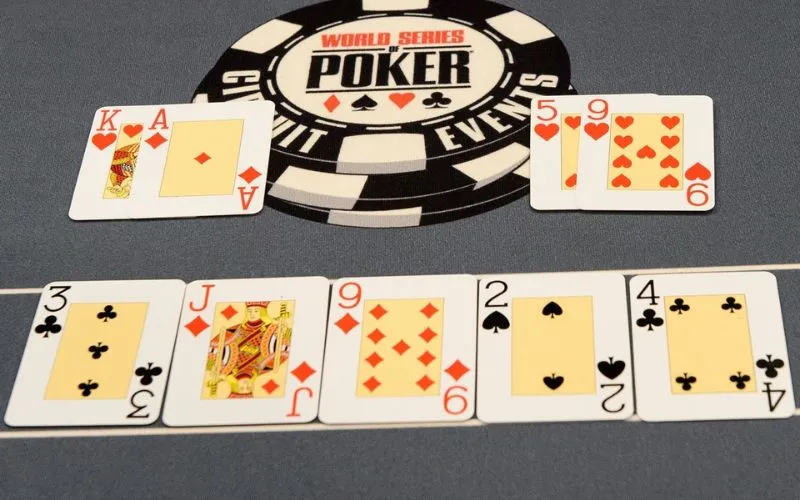
In a $1/$2 cash game, you raise the button to $6. The small blind, a solid player, calls you, and the big blind folds. There is now $14 in the pot, and the flop is. For the small blind checks, you decide to bet $8 on the loss and the small blind calls. The turn is the small blind checks, and you decide to check behind. The river is the, and your opponent contains again. This is a common situation where many people check behind:
But let’s narrow his hand range down quickly.
Since this is a solid opponent, he would have most likely re-raised pre-flop with a strong Ace, AA, KK, or QQ and likely folded a weak Ace. So there is only a small range of Aces that he could have in his hand. There is a heart draw on board, so sometimes, he will bet the flop or check-raise with a hand like AT or AJ since you could be semi-bluffing a draw. The same will go for a set. He could have 22, 33, or 44, but those would have most likely check-raised the flop or bet the turn.
His check on the river narrows his range to flush draws and mid-pocket-pairs. Could he have a hand? Sure, but that represents three specific combinations of hands. He could also have 55,66,77 and 99, and since there are six ways to make a pocket-pair, this is 24 combinations. So, of the 27 combos of non-Ace hands that might call you, you are beating 24. This is a spot where we can profit by betting for thin value.
We can’t bet too much if we try to get a pocket pair to call us with two over-cards on the board. He has to be either a calling station or a thinking player who will assume we are bluffing the river some percentage of the time. If they can justify that they are ahead or we are capable of bluffing here 20-25% of the time, we can effectively bet roughly 20-25% of the pot for them to think they are making a good call. The bank now has $30, so we should go for thin value and bet about $7-$8. It’s such a small bet that it will get called a high percentage of the time, and while it might seem silly to bet an amount so small, if we encounter this situation once every 200 hands, we are making an extra $300-$350 over a small sample of 10,000 hands.
A word of caution: When you go for thin value, you must also be prepared to fold to a raise. This is where betting for lightweight can be tricky. There are times when you are beaten, and there are times when your opponent may read your small bet as weak and will raise you on a bluff. This will depend on how your opponent views your play, so before you make your bet, plan for what might happen if your opponent raises it.
Setting Up Your River Bet

Before you get to the river, how you play the flop and turn can dictate how much value you get from your bet. While this applies to both cash games and tournaments, in tournaments, you will often be looking to strategically size your chances to get all the chips in the middle by the river. Here’s an example:
The blinds are 100/200, there are 2,000 chips in the pot on the turn, and you have 3,500 in your stack. For the sake of the example, assume you have a big hand like a set on an Ace high flop. If you check the turn, trying to slow play the most, you can bet on the river, which is probably 1,000 or 1,250. Betting more looks like you are committing your stack and will show you have a strong hand. However, if you bet 1,250 on the turn instead, the pot on the river will now be 4,500, and you will only have 2,250 in your stack. You can now go all-in on the river and give your opponent 2-1 on a call. Ultimately, you earned 3,500 by betting the turn instead of the 1,000 you would have earned by playing tricky.
Conclusion
As you decide how to play a certain hand on the river, if you can narrow your opponent’s hand range to a specific set of hands instead of just “strong” or “weak,” you can find value where other players are not. This might be sizing it just the right amount (big or small) or deciding to bet instead of checking behind. No matter the situation, you should always ask yourself, “How can I make the most money out of this hand.”
Related Lessons


