

The Continuation Bet (C-bet)
A bet from a player on the flop who raised pre-flop is known as a continuation bet or simply a c-bet. That player has continued to seize the initiative, hence the term, continuation bet. The normal use of the continuation bet is by a player in position against a lone opponent who has checked on the flop. Using a continuation bet is rooted in the wisdom that, most of the time, one’s hand does not improve on the flop. Therefore the first player to bet may take down the pot immediately.
Over time, this strategy has almost become many poker players’ 100% default action. Up front, we will state that if players employ this poker strategy every time they take the pre-flop lead, they continue betting too frequently. When this happens, what can be utilized selectively to one’s benefit can become a major leak. As in all of poker, predictability is analogous to stepping into the crosshairs of all but your most obtuse opponents.
In this lesson, we will attempt to explore the why, when and against whom this action should ideally be taken. We recommend counter strategies for when your opponent makes a continuation bet.
The Purpose of Continuation Bets
As stated above, the strategy is based upon the fact that a hand is not usually improved upon by the flop, so attacking your opponent with further aggression, regardless of your holding, can many times win the pot. It can also be used as a reverse bluff when you hold a strong hand and want to build the pot. The main purpose, however, is to win the pot immediately.
The Number of Opponents
The fewer opponents you are facing, the higher your chances of success in winning the pot with a continuation bet. As a general guide, consider the following:
- C-bet almost 100% when heads up
- C-bet 50% when against two players
- C-bet 25% when against three players
Continuation betting against more than one opponent, while much less frequently, gives your game a degree of unpredictability. Although if there are four or more players, you’ll probably want to hit the flop before sending more chips toward the middle – and a check may be in order.
The Texture of the Board
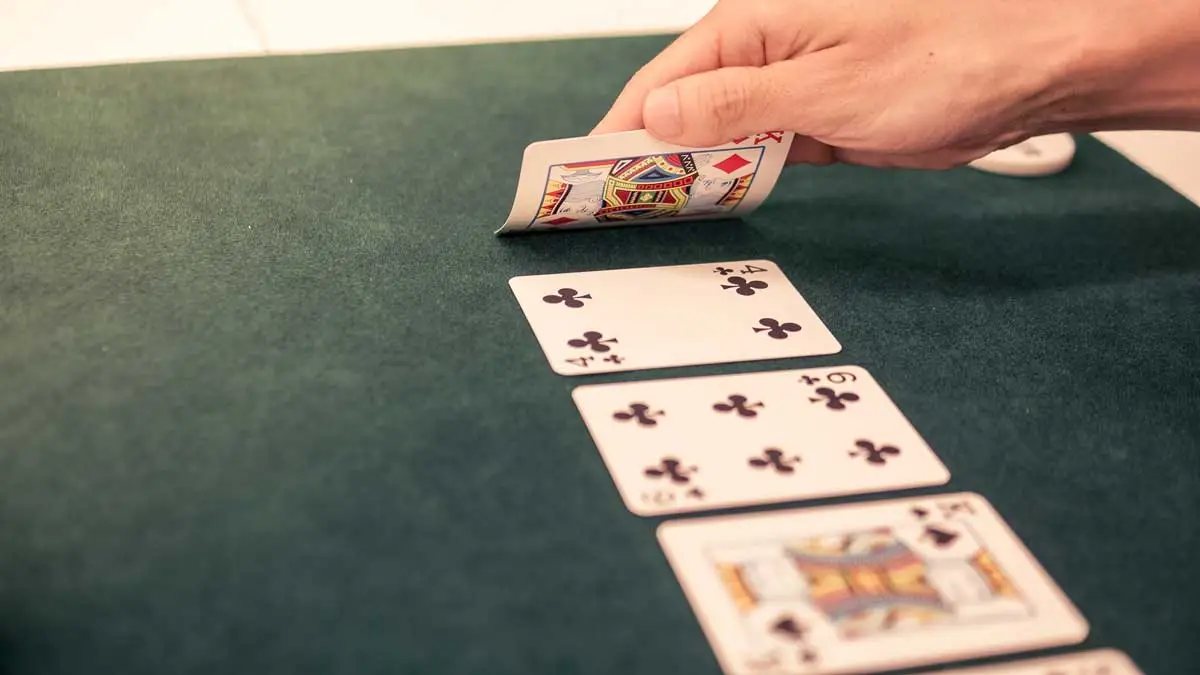
As the Mad Genius of Poker, Mike Caro, has stated… hold’em is a game of high cards, while the stud is a game of live cards. Keeping that counsel in mind, if the flop comes to Jack, Queen, and King, there is a high likelihood that one of your opponents may be holding a match to one of these wheelhouse cards. They weren’t calling your pre-flop raise with 6-3 offsuit!
The flop’s texture is critical to whether a c-bet is the play with the best expectation. Aside from high cards, be careful of coordinated boards that favor straight and flush draws. Ideally, you’ll want to see a ragged rainbow flop.
Let’s look at a few examples. Suppose you raise with and get called by the button and the blinds. The flop comes :
Figure 1
This is not a good spot to c-bet. You’re against three opponents, and your hand value is only an inside straight. You missed your high cards and flush potential, and one of your opponents could have easily connected with such a flop. If you checked too, then check, and I hope you get a free look at the turn. If you bet and then get raised by the button or check-raised by one of the blinds, you would have to fold, so see if you can hit your draw on the turn.
Let’s suppose you’re holding the same hand, yet this time you’re against a single opponent, and the flop is dealt :
Figure 2
This is a completely different situation, and if your opponent checks, it’s a great time for a semi-bluff c-bet to either take the pot right then or, if called, you have two overs and the second nut flush draw. Unlike the previous example, it would also be a good time to make a continuation bet if you faced multiple opponents.
You can also make a continuation bet when you flop a strong hand, such as a set. Remember that in poker, playing different hands the same way is important. If you regularly make continuation bets when you whiff on the flop, you should also bet when you make a strong hand, too – not to arouse suspicions. Your intention in poker is to manipulate your opponents, and one advantage of frequently c-betting is that you will give your good hands some cover and disguise.
Bet Sizing
If you’re playing no-limit hold ’em, you must decide the size of your wager when planning a continuation bet. Many factors should contribute to your decision, including opponent playing tendencies, stack sizes, and your own table image. You need to balance your bet size for two reasons. Understanding that the strategy is not foolproof… you don’t want to bet too small, which will invite a call, and to bet too large becomes foolhardy.
But it’s important to be consistent with your betting. Therefore your continuation bets should be the same size as any other post-flop betting, and conventional wisdom seems to favor a bet size of at least half the pot. To bet less extends better calling odds to your opponent, and to bet more becomes too costly when you run into an opponent that actually has a hand. This is not a hard and fast rule, and you’ll find yourself making adjustments through experience, feel, and the general nature of the game.
Your Opponents
While it is true that knowing how you believe your opponents will react is a universal poker criterion to successful play, when betting on an opponent with nothing, it is good to know how tight or loose he may tend to play.
In addition, just as you are making a play, maybe your opponent. Is he savvy enough to be floating you? This is a play in which your opponent may suspect you are continuation betting, so he just flat calls expecting you to check on the turn. If you do check after he calls your continuation bet, he intends to seize upon your apparent weakness and bet to steal the pot.
The factors outlined above are the major evaluation criteria to determine the wisdom of making a continuation bet. In a perfect situation, you should be in position against a single weak/tight opponent, making a bet of about half the pot into a raggedy board. The half-pot bet will offer him 3-to-1 odds which aren’t very good drawing odds. If you know your opponent is knowledgeable regarding drawing odds, this becomes a positive to offering him poor odds to a possible draw.
Countering the Continuation Bet
Now let’s take a look at the same situation in the mirror. Instead of aiming the shotgun at a lone opponent, we’ll imagine you are looking down the barrel of the continuation better. At the risk of sounding like a broken record, always be observant of your opponents to improve your decision-making. Is he aggressive, loose, timid, and tight, or where does he dwell in that range? Many players love to see a flop and then feel compelled to fire a continuation bet to end the action. Know your opponent’s tendencies – this knowledge pays dividends.
Reverse Engineering

Reverse engineering is a term used in many fields to describe a process wherein you first dissect a competitor’s product, marketing plan, or just about anything to determine how it’s made or done with the intention of replicating it or improving upon it. The best way to combat an opponent continuing betting is to understand his thought process and, if appropriate, play back at him. Review the following checklist to determine if an opponent’s continuation bet is manipulating you.
- Does he regularly, therefore predictably, continuation bet?
- Does his bet warrant a call based on your hand?
- Based on his tendencies, is he attempting to steal the pot?
- If he is stealing, should you raise, call, or fold?
Identifying the Meaning of Your Opponent’s Bets
There are many different types of bets in addition to continuation bets… value bets, probe bets, and semi-bluffs as examples. Nothing is worse than attempting to thwart what you believe is a continuation bet by calling all the way to the river only to face the ultimate revelation that your opponent was value-betting the whole time.
Knowledge is power, and it is up to you to observe your opponent’s betting patterns to understand how they play the game. This knowledge will help you make quality decisions, and when all is said and done – making quality decisions separates the winners from the losers.
Conclusion
Continuation betting is a solid poker strategy when the above criteria are in place. However, it should represent only one arrow in your quiver of ploys. As in all of poker, don’t use it every time you have been the pre-flop aggressor, as you will become predictable and, therefore, exploitable. Instead, observe your opponents and determine who among them does not understand the wisdom of mixing up one’s game.


